Usage
This section provides examples of how to use the ICSpyLab package. The core of the package is the ICS class. The implementation is similar to the sklearn framework, including a fit-transform logic. For more information about the arguments and methods, check out the Module page.
Example 1: Fitting the ICS model
import pandas as pd
from icspylab import ICS, cov, covW
from sklearn.datasets import load_iris

# Load dataset
iris = load_iris()
X = pd.DataFrame(iris.data, columns=iris.feature_names)

# Instantiate ICS object
# ics = ICS() # default parameters
ics = ICS(S1=cov, S2=covW, algorithm='standard', S2_args={'alpha': 1, 'cf': 2})

# Fit and transform the ICS model (equivalent of the function ICS-S3() from the R package ICS)
ics.fit_transform(X)

# Printing a summary
ics.describe()
Example output:
ICS based on two scatter matrices
S1: cov
S1_args: {}
S2: covW
S2_args: {'alpha': 1, 'cf': 2}

Information on the algorithm:
algorithm: standard
center: False
fix_signs: scores

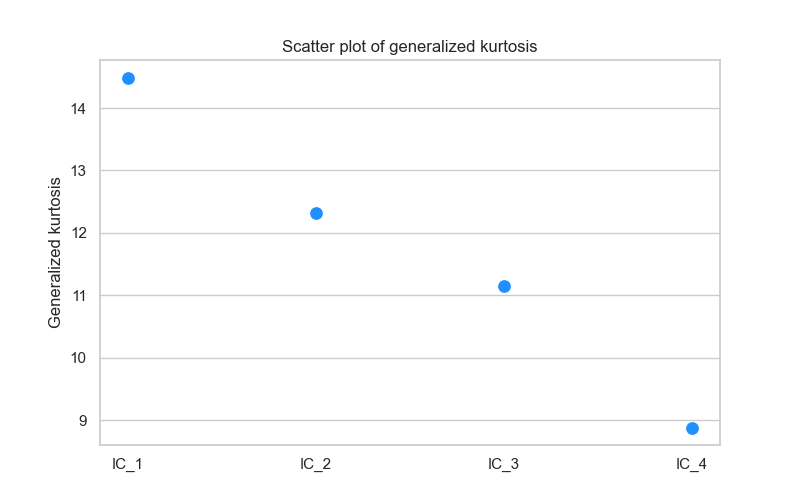
The generalized kurtosis measures of the components are:
IC_1: 14.4888
IC_2: 12.3233
IC_3: 11.1507
IC_4: 8.8856

The coefficient matrix of the linear transformation is:
     sepal length (cm) sepal width (cm) petal length (cm) petal width (cm)
IC_1       -0.52335      1.99326      2.37305     -4.43078
IC_2        0.83296      1.32750     -1.26665      2.78998
IC_3        3.05683     -2.22695     -1.63543      0.36544
IC_4        0.05244      0.60315     -0.34826     -0.37984
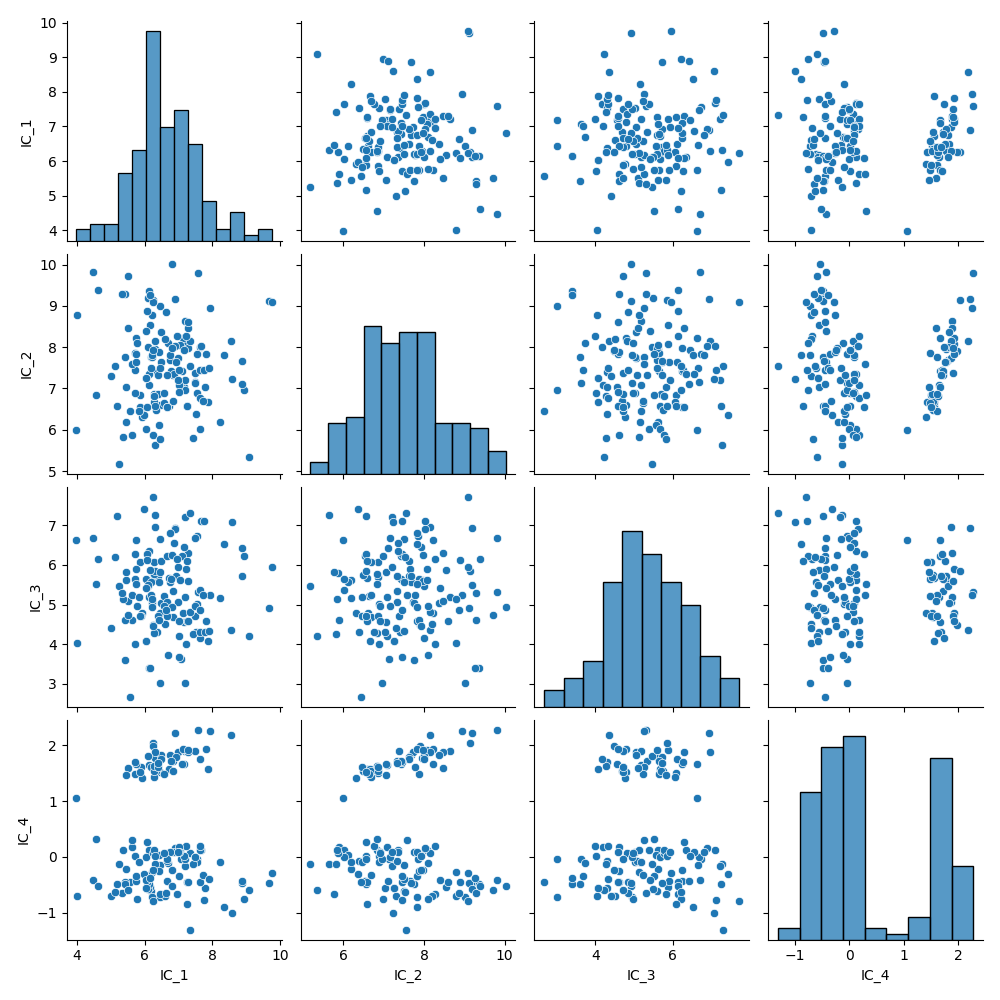
Example 2: Plotting transformed data
# Plot transformed data (scores)
ics.plot()
Example plot:
# Plot kurtosis (eigenvalues)
ics.plot_kurtosis()
Example plot:
Example 3: Fitting and transforming separately
from sklearn.datasets import load_iris
from sklearn.model_selection import train_test_split
from sklearn.linear_model import LogisticRegression

# Load the Iris dataset
iris = load_iris()
X = iris.data
y = iris.target

# Split the data into training and test sets
X_train, X_test, y_train, y_test = train_test_split(X, y, test_size=0.2, random_state=42)

# Create a logistic regression model with ICS as a preprocessing step
ics = ICS()
model = LogisticRegression(max_iter=200)

# Train the model on the training set
ics.fit(X_train)
X_train_ics = ics.transform(X_train)
model.fit(X_train_ics, y_train)

# Make predictions on the test set
X_test_ics = ics.transform(X_test)
y_pred = model.predict(X_test_ics)